
A Brief History of Business Automation
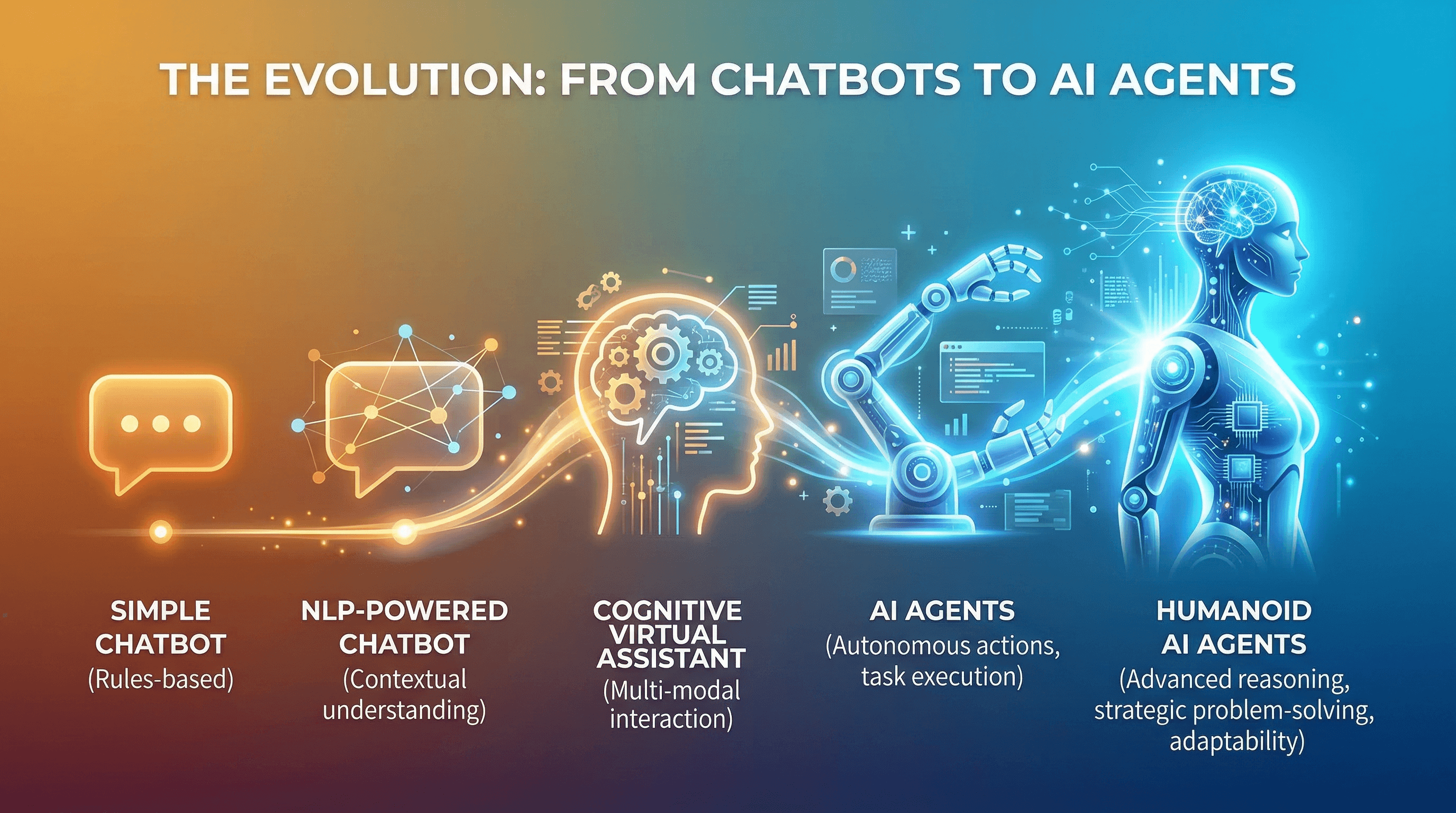
The journey from early chatbots to modern AI agents spans decades of technological progress. Understanding this evolution helps businesses appreciate what today's AI agents can actually do and, equally important, where they still have limitations.
Each generation of technology solved problems the previous one could not, while introducing new capabilities that changed what businesses could expect from automation.
Generation 1: Rule-Based Chatbots (2010-2017)
The first wave of business chatbots operated on simple decision trees. If a customer typed a keyword, the bot matched it to a predefined response. These systems were:
- Rigid -- They could only handle scenarios explicitly programmed by developers
- Keyword-dependent -- Minor variations in phrasing caused failures
- Stateless -- Each message was processed independently with no memory of context
- Frustrating -- Users quickly learned to type keywords rather than natural sentences, or gave up entirely
Despite their limitations, rule-based chatbots proved one critical concept: customers were willing to interact with automated systems for simple tasks. Companies that deployed them saw that 20-30% of inquiries could be handled without human intervention, even with primitive technology.
What they could do:
- Answer FAQs with predefined responses
- Route inquiries to the correct department
- Collect basic information (name, email, issue category)
What they could not do:
- Understand natural language beyond keywords
- Handle multi-turn conversations
- Learn from interactions
- Take actions in external systems
Generation 2: NLP-Powered Chatbots (2017-2022)
Natural Language Processing transformed chatbots from keyword matchers into systems that could understand intent. Technologies like BERT and GPT-2 enabled chatbots to:
- Understand variations in how people express the same request
- Detect sentiment and adjust responses accordingly
- Maintain context across a conversation
- Handle multiple languages with reasonable accuracy
This generation significantly improved the customer experience. Resolution rates climbed to 40-50% for automated handling, and customer satisfaction with bot interactions improved notably.
Key improvements:
- Intent recognition across phrasing variations
- Entity extraction (dates, names, order numbers) from natural text
- Basic conversation memory within a session
- Sentiment-aware responses
Remaining limitations:
- Still fundamentally reactive, waiting for user input
- Limited to conversation, unable to take actions in business systems
- No ability to handle complex, multi-step processes
- Required extensive training data for each new use case
- Could not reason about novel situations
Generation 3: AI Agents (2023-Present)
The current generation represents a qualitative leap. AI agents are not just better chatbots. They are a fundamentally different category of software. The key distinction is agency: the ability to perceive, decide, and act autonomously within defined boundaries.
Core Capabilities
Autonomous Decision-Making AI agents evaluate situations and choose actions based on goals, context, and available information. A customer service agent does not just respond to questions; it decides whether to issue a refund, escalate to a specialist, or proactively offer a solution based on the customer's history and the company's policies.
Tool Use and System Integration Modern AI agents can interact with external systems: databases, APIs, CRMs, ERPs, email systems, and more. They do not just generate text responses. They execute real business actions like updating records, placing orders, sending notifications, and generating documents.
Planning and Reasoning Given a complex goal, AI agents can break it down into steps, determine the right sequence, and adapt their plan based on intermediate results. If one approach fails, they can reason about alternatives rather than simply reporting an error.
Contextual Memory AI agents maintain understanding across interactions, remembering previous conversations, customer preferences, and ongoing issues. This enables continuity that was impossible with earlier generations.
Multi-Modal Understanding Modern agents can process text, images, documents, and structured data. A claims processing agent can read a photograph of damage, extract information from an insurance policy PDF, and compose a response, all within a single workflow.
The Practical Differences
To illustrate the gap between chatbots and AI agents, consider a common scenario: a customer contacts a Swiss retail company about a delayed order.
Chatbot Response
- Matches "delayed order" keywords
- Asks for order number
- Retrieves order status from database
- Displays status: "Your order is in transit"
- Offers to connect to a human agent if unsatisfied
AI Agent Response
- Identifies the customer and retrieves their history
- Checks the order status and shipping tracking data
- Recognizes the delivery is 2 days late due to a carrier delay
- Checks company policy for late delivery compensation
- Proactively offers a 10% discount on the next order per policy guidelines
- Contacts the carrier API to request expedited delivery for the remaining leg
- Sends the customer a personalized message in their preferred language with the updated delivery estimate and discount code
- Logs the interaction and flags the carrier's performance issue for the logistics team
- Updates the CRM with the resolution details
The chatbot tells the customer what they already know. The agent solves the problem.
What This Means for Swiss Businesses
The evolution from chatbots to AI agents has specific implications for Swiss companies:
Multilingual Advantage
Switzerland's four-language environment was always challenging for chatbots, which required separate training for each language. AI agents handle multilingual interactions natively, switching between German, French, Italian, and English within a single conversation without degradation in quality.
Regulatory Compliance
AI agents can be configured with explicit compliance rules, ensuring that every action they take adheres to Swiss regulations. Unlike chatbots that simply display information, agents that execute actions must be designed with compliance built into their decision-making logic.
Integration with Swiss Business Systems
Swiss companies often use a mix of local and international business systems. AI agents' ability to integrate with multiple systems through APIs makes them well-suited to the heterogeneous technology landscapes common in Swiss enterprises.
Making the Transition
For companies currently using chatbots, the transition to AI agents does not require starting from scratch. The knowledge built into existing chatbot systems, including FAQs, workflow definitions, and integration points, provides a valuable foundation.
The transition typically follows this path:
- Audit current automation -- Document what your chatbots handle, where they fail, and what humans do after handoff
- Identify agent opportunities -- Look for processes where chatbot handoffs lead to repetitive human work
- Deploy targeted agents -- Start with one high-impact process where an agent can handle the full workflow
- Measure and expand -- Use results from the first deployment to build the case for broader adoption
The Road Ahead
AI agents will continue to evolve. Near-term developments include better reasoning capabilities, more sophisticated multi-agent coordination, and improved ability to learn from organizational knowledge. The companies investing in agent infrastructure today are positioning themselves to benefit from these advances as they arrive.
SWISS.Ai helps businesses transition from basic automation to intelligent AI agents. Whether you are starting from scratch or looking to upgrade existing chatbot systems, our team can design and deploy AI agents that deliver real business value. Contact us to discuss your automation journey and discover what the next generation of AI can do for your organization.